

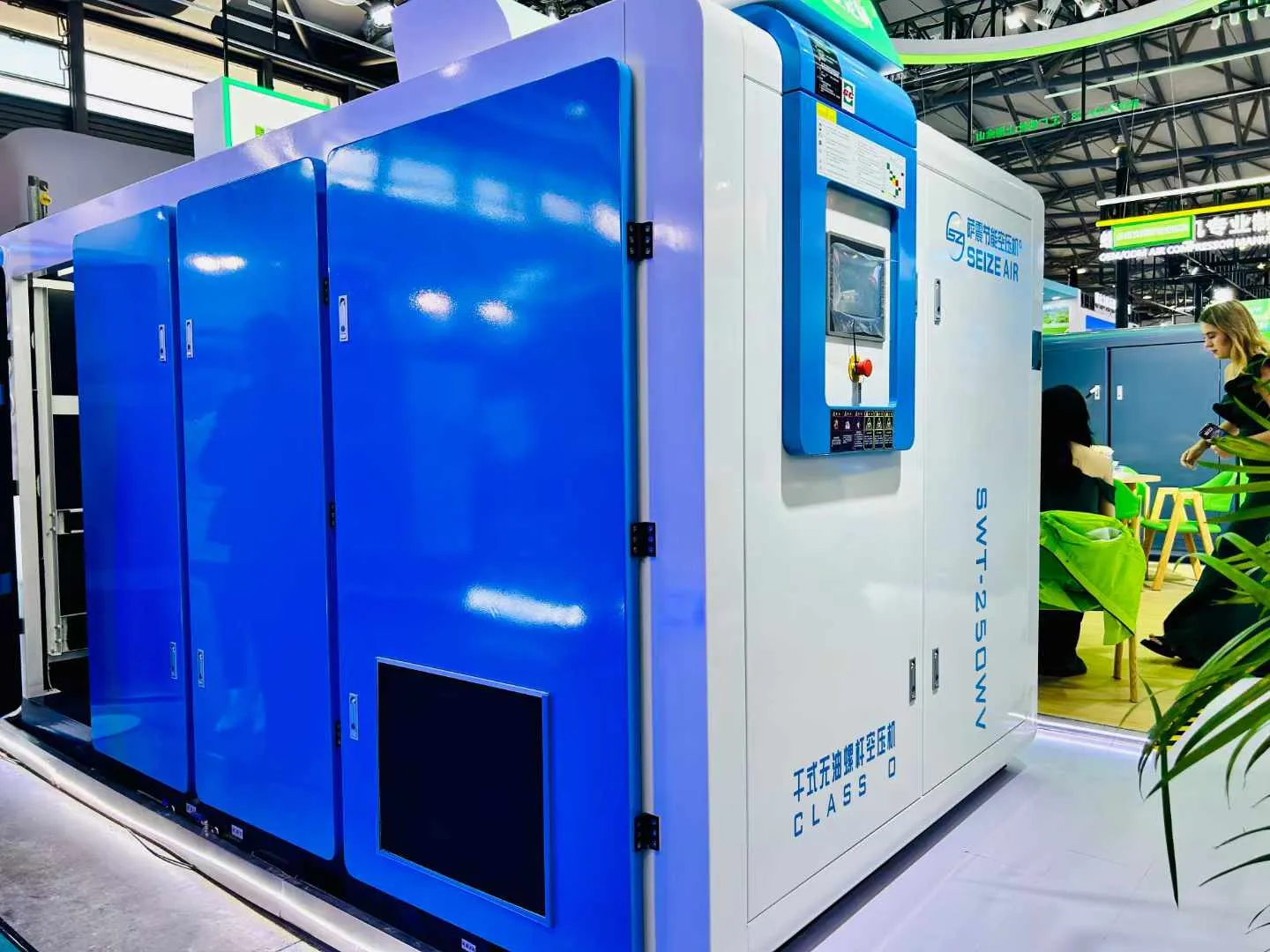
Understanding Specific Power Ratio (SPR)
The SPR is calculated as:
\text{SPR} = \frac{\text{Electrical Energy (kW·h)}}{\text{Compressed Air Volume (m³)}}
A lower SPR indicates better energy efficiency. However, achieving optimal SPR requires addressing regional challenges such as climate, infrastructure, and regulatory standards.
Regional Challenges and Opportunities
1. Southeast Asia: Humidity and High Temperatures
- Climate Impact: Tropical climates in countries like Thailand, Indonesia, and the Philippines lead to high humidity and ambient temperatures, which reduce compressor cooling efficiency.
- Solution:
- Use oil-free compressors to avoid oil degradation in humid conditions.
- Install aftercoolers and drain systems to manage condensation.
- Opt for variable-speed drives (VSDs) to match airflow with real-time demand, reducing energy waste.
2. Middle East: Extreme Heat and Dust
- Climate Impact: Countries like Saudi Arabia, UAE, and Qatar face extreme heat (often exceeding 50°C) and dusty environments, accelerating component wear and overheating.
- Solution:
- Choose air-cooled compressors with robust cooling systems and dust-resistant filters.
- Implement remote monitoring systems to detect overheating or inefficiencies early.
- Prioritize compressors with high ambient temperature ratings (e.g., up to 50°C).
3. Europe: Strict Energy Regulations and Urbanization
- Regulatory Impact: The EU’s ErP Directive mandates minimum energy efficiency standards for compressors, penalizing non-compliance.
- Urban Challenges: Limited space in industrial zones requires compact, low-noise compressors.
- Solution:
- Adopt IE4/IE5 premium-efficiency motors to meet EU regulations.
- Use modular systems for space optimization and scalability.
- Leverage digital twins for predictive maintenance and real-time SPR monitoring.
Global Best Practices for SPR Optimization
- Right-Sizing Compressors: Avoid over-specification; match compressor capacity to actual demand.
- Pressure Management: Reduce system pressure by 1 bar to cut energy use by ~5–8%.
- Leak Detection: Regular audits can eliminate leaks, which waste up to 30% of compressed air energy.
- Smart Controls: Deploy IoT-enabled controllers to automate load management and reduce idle time.
Case Studies: Regional Success Stories
- Malaysia: A manufacturing plant in Penang reduced SPR by 22% by installing VSD compressors and fixing leaks, saving $150,000 annually.
- Saudi Arabia: A petrochemical firm in Riyadh upgraded to dust-resistant compressors, cutting downtime by 40% and energy costs by 18%.
- Germany: A automotive supplier in Munich adopted EU-compliant compressors with digital monitoring, achieving a 25% efficiency gain.
Future Trends in Compressed Air Efficiency
- Renewable Integration: Solar-powered compressors are gaining traction in sun-rich regions like the Middle East.
- AI-Driven Optimization: Machine learning algorithms will further refine SPR by predicting demand patterns and adjusting compressor performance.
- Circular Economy: Recycling compressed air heat for industrial processes (e.g., drying or heating) is becoming standard in Europe.
Conclusion
Optimizing the specific power ratio of air compressors is not a one-size-fits-all solution. By tailoring strategies to regional climates, regulations, and infrastructure, industries in Southeast Asia, the Middle East, and Europe can significantly reduce energy costs, meet sustainability targets, and future-proof their operations.
? Phone: +86-15021218862
? Email: sales@seize-air.com


